
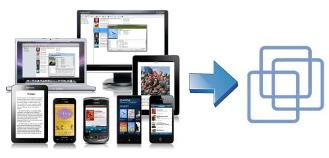
 Cisco recently presented the result of a global survey conducted in 2011 on the perception of IT managers on the significance of enterprise presence of the tablet-mobile devices. Cisco partnered with Redshift Research to do the study on 1500 IT manager and executive respondents from the US, UK, Canada, France, Spain and Germany. They were commissioned to assess and examine the hopes and fears of the respondents on the rise of use for tablet-mobile devices in the workplace.
Redshift chose the survey respondents based on various genres of global companies from small-medium-large scale enterprises. The respondents were picked for their significance in IT decision making capabilities for the company.
Redshift Results:
– The results showed that most IT departments requested at least one tablet PC for every three smartphones for the department.
– US and France topped the lead with each recorded 20% tablet request from their workforce. For senior executives in the US, request for tablet PCs recorded 38% and UK placed next with 27% tablet request.
– Spain got the top spot as the most excited for this trend, which recorded 90% who believes that tablet PC will raise in popularity in the coming years.
– Tablet PCs are widely used in Germany by as much as 31% from the company’s sales team, while the rest of the countries recorded 21% on the average.
– Although US is considered the most experienced with tablet PCs they also posed the most concerns with security issues, which ranked number 1 at 75%.
– 48% of the IT respondents said that access to applications should be controlled and restricted to employees. UK and Canada shared this fear that recorded 56% and 55% respectively.
– All respondents agreed that tablet PCs will give more advantages for the company and the business.
– Almost 75% of the respondents agreed that document sharing and email are still the must-haves for any enterprise. Almost 50%, on the other hand, said IM, video conferencing, data access and seamless synchronization with other applications and devices must also be considered.
– The survey also said that on the global market, 48% of employers would not permit employees to bring their own device (BYOD-bring your own device) in the workplace. 57%, however, said that, in spite, of the restrictions employees still bring their devices at work. 51% of the respondents confirmed that BYOD continues to be on the rise in the workplace.
– In the US, it got the highest percentage of 64% on employees bringing personal devices without consent, while Germany got the lowest at 49%.
– 64% of the respondents said that the biggest problem faced with BYOD is the issue on employee access. 44% said that BYOD brings the focus out of important business projects.
Director of product management, IPCBU, Cisco Systems, Tom Puorro said, “Mobile workers and virtual workspaces are here to stay — but so are the demands on IT to continue to ensure enterprise-grade security, manageability and interoperability. 2012 promises to be an exciting year and IT leaders are a critical component in unleashing innovation and enabling organizations to take advantage of the next wave of business growth and opportunity. Cisco is keenly focused on helping its customers navigate the post-PC era and transform their business.”
