Social CRM – Opportunities and Challenges for Enterprises
While social media and social networking have changed the way people connect and communicate with each other, the implications for businesses of all sizes are also significant. The “social consumer” is in the spotlight and shares his customer experience and opinions on a massive scale with other consumers – worldwide. This has a ground-breaking effect on customer relationship management (CRM) and the way that businesses communicate and interact with their customers. It’s all about customer insights, transparency, developing credibility and increasing sales. Enterprises will need to redefine the way they manage their ‘customer relations’.
What is Social CRM?
Social CRM offers a whole range of new and powerful ways to build loyalty, market, sell, and otherwise influence existing or potential customers on the web. The rules of the game are ever changing and they are changing fast. However it is critical to understand that ‘Social CRM’ is not replacing traditional CRM. It is only meant to enhance the existing CRM infrastructure and expand it. Instead of offering a simple two dimensional database on leads and opportunities, tracking customer name, title, department, age etc., Social CRM offers additional depth and information that is found on social networking sites, short messaging services or through comments and participation. Paul Greenberg summarizes Social CRM (or SCRM) in the following definition:"CRM is a philosophy & a business strategy, supported by a technology platform, business rules, workflow, processes & social characteristics, designed to engage the customer in a collaborative conversation in order to provide mutually beneficial value in a trusted & transparent business environment. It's the company's response to the customer's ownership of the conversation."According to Gartner:
„Social CRM comprises applications with very different approaches for supporting communities of internal users, customers, partners and other stakeholders to assist with sales, marketing and customer services processes for the mutual benefit of enterprises and their customers.”
Challenges for Enterprises
The critical challenge for most companies lies not necessarily in the vendor selection of a Social CRM Solution, but rather in changing the mindset of the sales and marketing function of their organization. The involvement of companies in social media and social networking is not a choice for most companies. It’s a given. Their customers are already on the web, talking about their products and services, giving advice, commenting, complaining, asking etc. Companies should begin by simply listening to what their customers are saying.Listening is a good start, but to change the mindset of a corporate culture, some significant investments are needed. Companies need to get away from a product-centric, transactional handling of customer interactions, towards a long-lasting, transparent and honest communication. This will create ultimately more valuable relationships with customers.
Increasing Customer Value
Social CRM involves both proactive marketing, sales, and service and reactive preemption and mitigation. As described above, it is not only important to select the right Social CRM tools, but to change processes and build capabilities. According to Booz & Company, a management consultancy, companies seeking to build new Social CRM capabilities must “adapt, augment, and rethink their product, channel, and customer strategies as well as their attendant delivery processes, tools, people skills, incentive systems – indeed the entire corporate culture.”A successful Social CRM effort lies in protecting the bottom line of CRM management, while growing the top line of 1) Lead generation & Social Sales, 2) Social Marketing & Promotions, 3) Brand & Product Awareness, and 4) Loyalty & VIP Customer Treatment.
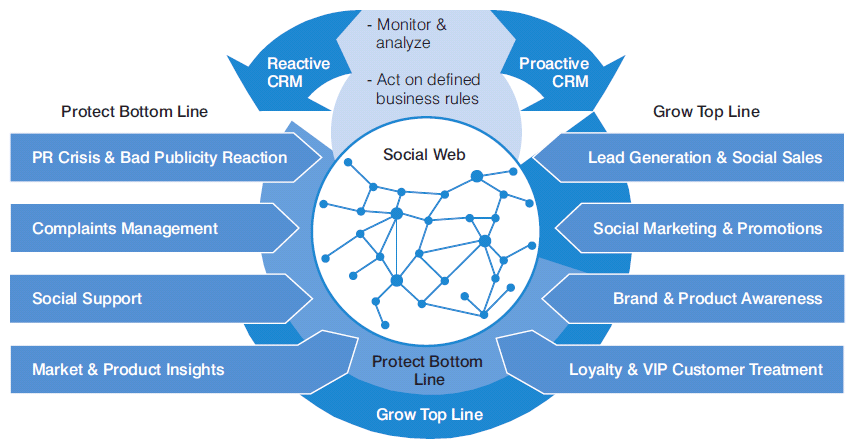
Source: Booz & Company
The traditional CRM was mostly about reactive efforts of answering the phone, using web-to-lead forms, etc., proactive CRM is improving the “social web credibility” to increase e-commerce revenues. Reactive and proactive CRM efforts must be accomplished together. As mentioned earlier, Social CRM is not replacing traditional CRM, but extending it.
Gap Learned a Lesson
Many companies have been facing Social CRM issues without their consent. Again, it’s not a decision for enterprises to participate in Social CRM, they are already participating. The clothing store, Gap, surprised its community with a new corporate logo in October 2010 and was immediately criticized and attacked by the Internet community who preferred the old logo. Thousand of comments were posted on Facebook and other social networking sites – mainly negative. Only five days later, Gap dropped the new logo and returned to the old version. “We recognize that we missed the opportunity to engage with the online community,” said Marka Hansen, president of Gap North America, in a statement. A lesson learned.Dell Swarmed
The computer electronics company, Dell, has invested heavily in social media tools and integration over the last years. In partnership with Intel, Dell launched the group buying program “Dell Swarm” which allows customers to communicate about special offers through their networking sites and then buy a product collectively. The more people signed up, the lower the price. The group buying concept has only recently achieved a prominent success with Groupon beating all expectations. For Dell it has certainly paid off as well, with US$6.5 millions in incremental revenues.Social CRM Tools
Gartner categorizes Social CRM applications into social monitoring, customer- and partner-hosted communities, enterprise feedback management (EFM), product reviews and sales contacts. The main interest has interestingly not risen from sales organizations, but from marketing and customer service departments. There are over 100 vendors for Social CRM application alone and merger & acquisitions are increasing drastically.Gartner has released its Magic Quadrant for Social CRM in June 2010, classifying key players in the industry in niche players, visionaries, challengers and leaders. Jive Software and Lithium are the only two companies considered as leaders in that space.
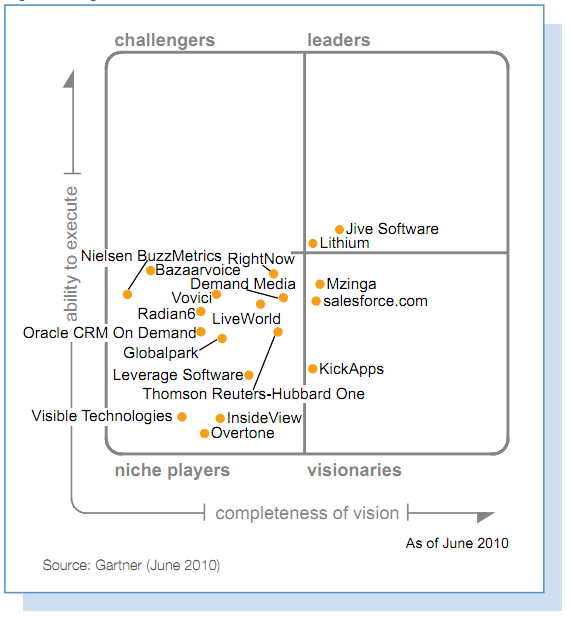
Source: Gartner
The industry has certainly advanced significantly, however there is still road ahead. Distinguishing useful data from the noise created by millions of Internet users remains one of the challenges. Once the solutions are able to restructure the data automatically so that management information system can process it, we’d be another leap forward.
George Cathcart
PR+MKTG Camp/Dan Greenfield
admin